Buying an apartment in Morocco: understand co-ownership before signing
Charges, works, accounts and decisions: a practical method to examine co-ownership before buying an apartment in Morocco.
When viewing an apartment, you usually have a clear picture in mind: light in the living room, the number of bedrooms, the commute and the price. The building’s accounts or a meeting of its co-owners tend to receive less attention. Yet your home does not stop at the front door. A lift that regularly breaks down, a poorly maintained shared terrace or work with no clear funding can affect everyday life and your budget long after the purchase.
Before signing in Morocco, take time to understand the co-ownership arrangement you are joining. You do not need to become an accounting specialist. You need to know what you will pay, how decisions are made and which problems remain unresolved. This approach matters for a main residence, a rental investment or a second home used for a few weeks each year.
You are buying an apartment and a share in collective life
Start by distinguishing what belongs to your home from what belongs to the building. A parking space, cellar or terrace may be presented as an advantage of the apartment. Ask for its status to be clarified in the documents. A space that an occupant has used for years is not necessarily one they can use freely or sell along with their home.
This also matters for future plans. If you want to convert a room, install outdoor equipment or change the appearance of a balcony, do not simply note that other residents have done so. Ask which rules apply to your unit and which authorisations will be needed. A practice visible in the building does not replace a documented agreement.
Keep two separate lists during the viewing. The first concerns the apartment: windows, plumbing, rooms and equipment. The second concerns shared areas: access, lighting, stairs, lift, garage and roof. Our guide to assessing comfort during a viewing complements these observations. A lovely living room deserves attention, but so does the route you take to reach it.
Understanding the Moroccan framework without getting lost in legal texts
Law No. 18-00 on the co-ownership of built properties, in the version published by the Ministry of Justice, governs matters including collective decisions, management and contributions to shared expenses. Articles 24 and 36 address the provisional budget and common expenses. The syndicat des copropriétaires is the collective body of owners; the syndic carries out the management entrusted to them. These are different concepts.
Decree No. 2-23-700, published in official translation in Official Bulletin No. 7466, page 3920, sets accounting rules and formats for presenting the accounts. The applicable format depends in particular on income for the accounting year. For a buyer, the practical issue is obtaining understandable, consistent documents. This guide offers a checking method without replacing a notary’s or a qualified professional’s analysis of your specific case.
Ask what the contribution actually covers
A monthly amount mentioned verbally is not enough to compare two residences. In one, it may cover a range of services; in another, some costs may be charged separately. Ask which services are included, what period the amount covers and how payment works. Also ask whether the figure refers to a current budget, an older amount or an estimate intended for future residents.
Security, cleaning, equipment maintenance and utilities in shared areas: identify the items that actually exist in the residence. Do not build your comparison around a marketing list. A swimming pool shown in a brochure may be closed; reception may operate only at certain hours. Note the advertised services and look for evidence that allows you to check how they operate.
Avoid assuming that the lowest charges mean the best deal. They may reflect a simple, efficient organisation. They may also reflect postponed maintenance or an incomplete budget. Conversely, high charges do not prove good management. The useful question is: what does this amount fund, and does the service provided meet your needs?
Read the decisions, not just the amount payable
Ask the seller for the latest available general meeting minutes, the budget and the accounts you can consult as part of your purchase. Start with decisions about works, equipment, financial difficulties and changes in management. You do not need to memorise everything. Note matters that will affect you and questions that need clarification.
Distinguish between a problem being mentioned, a study being requested, a quotation being presented, works being approved and a project already underway. These stages provide different levels of visibility over spending. A sentence such as “the facade will be renovated” leaves many unknowns. What programme has been selected? At what cost? With what funding? On what schedule? Who will provide copies of the relevant information?
If documents seem contradictory, ask for an explanation before committing. An old budget may have been replaced; a schedule may have changed. It is better to notice a change and understand it than to assume that the most reassuring document is necessarily the one that applies. Keep important answers in writing, with the date and the name of the person responding.
Unpaid contributions and cash flow deserve a clear question
A residence may have a balanced budget on paper yet struggle to pay its suppliers. Ask how management tracks expected amounts, payments received and forthcoming expenses. The aim is not to obtain every future neighbour’s personal information. Seek an overall view of the situation and, for the unit being purchased, the supporting documents that the professionals handling the transaction consider necessary.
A total for unpaid contributions does not tell the whole story. It may involve recent delays, ongoing disputes or older amounts whose recovery remains uncertain. Ask how these difficulties affect the building’s services. Has maintenance been suspended? Have works been postponed? Have residents been informed that additional funding is needed? A precise answer is more useful than a reassuring phrase.
Do not draw conclusions about a person from a casual conversation with a neighbour either. Questions about debt, disputes or recovery require documents and, where necessary, legal advice. For the purchase, ask the notary how to check the unit’s position and how to address issues still unresolved between seller and buyer.
Anticipate works without inventing their cost
During the viewing, inspect common areas carefully. Water ingress, a damaged door or ageing equipment warrant a question; these observations alone cannot establish a repair cost. Photograph useful details with the necessary permission, note their location and ask whether an expert report or quotation exists. Bring in a professional when the building’s condition raises a significant technical uncertainty.
Future spending may concern individual repairs or a broader programme. Try to understand whether the co-ownership merely responds to emergencies or plans maintenance over time. You can ask simply: which works have been completed recently, and which are being considered for the coming years? Clarify what has been decided and what remains a possibility.
If your budget leaves no room for extra spending, this issue becomes essential. A purchase whose price feels comfortable may become difficult if you subsequently discover a substantial call for funds. Include available information in your complete purchase budget. Where a cost is unknown, identify the uncertainty rather than replacing it with a number chosen at random.
A fictional example to compare two apartments
Imagine two apartments offered at the same price in comparable surroundings. The stated contribution for the first is 300 MAD a month; for the second, 500 MAD. These amounts are entirely fictional and do not represent market rates. Over a year, they correspond to 3 600 MAD and 6 000 MAD respectively, a difference of 2 400 MAD.
Now suppose a document for the first building mentions an exceptional contribution of 9 000 MAD for the unit, payable during the year considered. In this example, the amount to allow for reaches 12 600 MAD, subject to how this expense is handled in the sale. The second apartment may appear less expensive that year even though its monthly contribution is higher. Compare an identified period and identified expenses.
This calculation is not enough to make a choice. Services, equipment condition, future works and how you will use the home remain decisive. Nor does it establish who must legally bear the exceptional contribution. Have that point checked in your transaction. The exercise shows why a monthly amount taken in isolation can give a misleading impression.
Clarify expenses linked to the change of owner
Before signing, ask how payments already requested, amounts still owed and works whose funding continues will be handled. Do not assume that a verbal agreement between you and the seller automatically resolves every issue concerning the co-ownership. The notary should explain the relevant documents, the commitments agreed upon and the consequences of the proposed arrangement.
Put these points in the sale file with the other documents to prepare before meeting the notary. Leaving a question until the final day may delay the transaction or push you into deciding too quickly. If information is missing, ask who must provide it and establish a checking stage before proceeding.
Plan practical matters too: whom to give your contact details to after the purchase, how to obtain access devices, where to find information about the residence and how to receive calls for funds. These small details help you avoid starting life as an owner with a missing access badge or a payment request that nobody has explained.
If you buy from abroad, keep communication simple
For a Moroccan living abroad, information may come through several people: seller, agency, relative, manager and notary. Establish a shared file and a list of questions. Ask that documents show their date, subject and, where useful, the unit concerned. A succession of voice messages is difficult to compare and can cause an important nuance to disappear.
If a relative views the property for you, give them a concrete task. They can observe access, note equipment that is out of service and request the listed documents. They should not have to improvise a technical diagnosis or legal opinion. Specify what they can check themselves, what must be confirmed in writing and what requires a professional.
After the purchase, arrange how you will receive information and organise payments. Make sure you can be reached even when outside Morocco. A rarely occupied home remains part of its building. The owner’s absence does not remove maintenance needs, collective decisions or matters to follow up with the person representing them.
A method for deciding without accepting reassurance too quickly
After your review, classify information into three categories: what you have observed, what the documents establish and what remains to be confirmed. For each important unknown, identify who must answer. This presentation helps you discuss matters with the seller without accusations and with professionals without starting from scratch at every exchange.
You can continue comparing homes while requesting clarification. Well-documented co-ownership does not guarantee that there will be no problems, but it helps you understand your commitment better. A late reply is not automatically evidence of misconduct; a succession of vague explanations about essential expenses, however, deserves clarification before signing.
The right apartment is not only the one you like during a viewing. It is also one whose collective management you understand and whose known expenses remain compatible with your budget. By reviewing charges, decisions and works methodically, you choose a home with a fuller picture of what lies ahead.
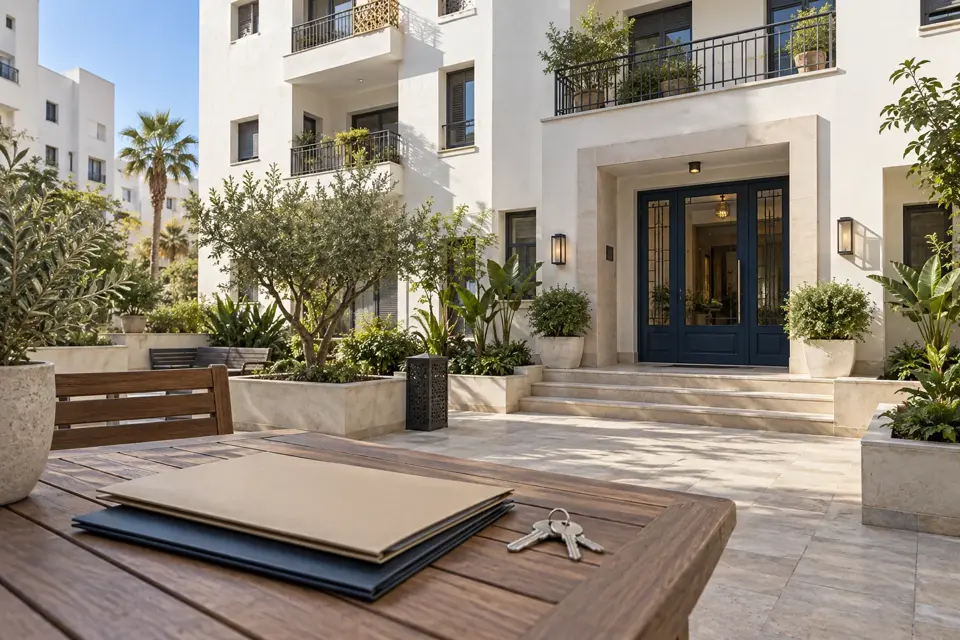
Original illustration generated for Darweb. This imaginary scene does not show a property offered for sale.